
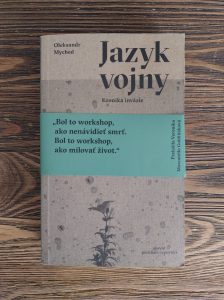
The work of a local journalist who documented fragments of his life during the Ukrainian war, sharing his experiences with the public with the raw immediacy of the moment.
The book is a collection of the author’s notes from various days of the conflict. It contains his thoughts and emotions, alongside descriptions of life as an ordinary person who chose to stay in a country, he feels immense pride and devotion toward. It is the story of a land where he grew up with his friends—a land that is now fading and bleeding under enemy attacks, where everyone is losing and bleeding. Emotionally charged lines alternate with pages that read like cold, hard reports. The book also weaves in the stories of several people the author encountered, all bound by three things: war, homeland, and a longing for victory.
The choice of the word ‘victory’ rather than ‘peace’ at the end of the previous paragraph was intentional. It is evident from the author’s writing that peace is no longer the only dream. The hatred he nurtures within demands more. He seeks justice, retribution, and a form of violence that would make Russia feel the weight of its guilt. It raises the question of whether we, as a civilization, have truly moved past the Hammurabian ‘eye for an eye’ principle. On the other hand, it must be noted that the author presents the book as a concept of individual, uncensored entries. Each is marked by the number of days passed since the start of the invasion. In contrast to the brief, clinical news headlines about the atrocities of war, we find the author’s profound reflections. Like many Ukrainians, Oleksander writes ‘russia’ with a lowercase ‘r’ and refers to russian soldiers as ‘orcs,’ explaining his natural resentment toward them in simple, fundamental language. He clearly distinguishes between good and evil, labelling Ukrainian soldiers as heroes—a portrayal that is understandable and essentially sympathetic. After all, every hero must face a stronger opponent, confront mortal danger, and maintain courage at the crucial moment. I understand all of this. Nevertheless, I believe that at times, his depiction of them may be perhaps a bit too romanticized.
One quote sums it all up: ‘I cannot imagine, in any parallel universe, Ukrainian soldiers entering a Russian city and starting to torture local civilians with electric shocks or raping individuals from age eight to eighty. Just as the Russians have done and continue to do here.’ To this, I would permit myself just one remark. My dear Oleksander, the fact that you cannot imagine it actually means very nothing. Disturbed individuals exist in every country, in every city… If a person lacks a moral compass and knows no one is watching, they can become a godforsaken beast. From start to finish, the ‘Enemy’ remains strictly defined. The author expresses his stance toward the whole of Russia—its soldiers, but also its ordinary citizens and artists. The core of his argument is that every single one of them bears a share of the guilt for what is currently happening in Ukraine. He blames the average Russian citizen for indifference, the artists for their inactivity, and the opposition for their fear of the ruling power. Oleksander, however, goes even further in his thoughts—so far, in fact, that it seems to me he is accusing the entire world of turning a blind eye. It was difficult for me to read certain passages because I found them impossible to understand. It felt as though the author is hoping for a fairytale-like reversal of the situation, where everyone joins hands and together, they defeat the ‘evil sorcerer.’ Then again, hope should never be denied to anyone—especially not to those for whom hope is the very reason they are still fighting. If I’m being honest, I expected more from the author. I have no issue with the chosen format, but something is missing. The alternating between clearly presented information, emotional reflections, and stories from the author’s surroundings didn’t disturb me, but it failed to leave me with the feeling of a ‘great book.’ It seems to me that none of the mentioned forms are truly developed, something the author could have put more effort into, as he undoubtedly had the space (frankly, descriptions of pets needing food don’t interest me when I’m faced with the reality of people dying elsewhere). Before buying the book, I knew the author was very highly regarded by the public; perhaps that is exactly where my disappointment stems from after finishing a book that I will likely never read again.
However, I did understand the author’s signal: Ukraine will not surrender because its individuals refuse to give up. The message to the world has been sent—a quote that mirrors the Ukrainian determination to endure: ‘The more of us they kill, the more of us there will be to testify to their crimes, because there is evil that can never be forgotten.’ I agree; the atrocities committed against people can never be forgotten. I hate wars.