
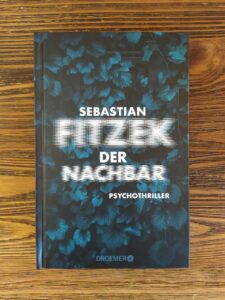
Another thrilling novel by Sebastian Fitzek features a woman fighting not just her past demons, but also unexplainable incidents happening in her life.
The Neighbour starts with a promising concept, taking us down a familiar road filled with relationship issues, psychopaths, aggressors, and potential serial killers. If Sebastian Fitzek mentions any kind of romantic relationship in his novels, you can count on one of the partners being seriously ill, getting divorced, cheated on, or dying. There are rarely any chances for a happy ending on his ship.
I often ask myself what motivates the writer to choose this kind of plot. It is not that I am looking for a fairy tale in a thriller, but having read multiple books by him, I can see a clear pattern. Somehow, it feels like the same story all over again. Not to mention, the main character always suffers from psychological issues as something from her past comes back to haunt her—like her dreams about her father locking her in her room, and the intentional or accidental killing of her baby brother. When you are a main character in a Fitzek novel, your life usually sucks. And quite a lot.
Returning to the plot, Sarah begins experiencing weird things in her daily life. These include the disappearance of old food leftovers, washed glasses, and someone installing a night light so she wouldn’t injure herself during nightly bathroom visits. One thing is certain: she was not mentally stable, but she never truly doubted her sanity in those instances. She knew something was off, and she was right—stalker mode was activated. This felt somewhat fresh, as we usually encounter paranoid characters whom no one believes, leading them to question their own sanity.
However, I found the idea of the black notebook to be a mixed copy of the manga phenomenon Death Note and Julie Garwood’s romantic novel Murder List. The black notebook and the method of killing seem borrowed from Death Note, while the stalker/murderer dynamic feels copied from Murder List. It often feels like the author copies ideas from different works. While I could understand her mental struggles, I did not understand the purpose of the black notebook. Why was there a need to write a detailed list of people she wanted to die in such specific, cruel ways? In my opinion, this was a part of the story where the author could have focused more. Nevertheless, I liked her intelligence and how she connected the dots. It wasn’t hard to link the first death of her old teacher to her vicious wishing—that was quite clear—but sometimes it takes a few more dead bodies to see the connections in between.
I had multiple guesses as to who the stalker could be. Initially, I thought he might help her deal with her abusive ex-husband at the end of the book. Then, around page two hundred, I suspected a family connection, thinking he might be her brother. This time, all of my guesses were wrong. It was a nice surprise to finally read an unpredictable revelation, as the stalker’s true identity was completely unexpected.
The first two hundred pages were great—thrilling and captivating. I did not want to put the book down. In the middle, however, the pacing slowed down significantly, which is usual for Fitzek. The writer is famous for his lengthy, overly artistic descriptions of the plot, situations, and characters. It often feels like he just wants to show off his eloquent vocabulary. I don’t need to read a page-long description of an older neighbour who isn’t relevant to the story. It would have been enough to state that he was old and lived next door; I wasn’t reading Tolstoy. Perhaps because of this, the ending lost its spark and felt boring. The suspense evaporated in the middle, and the book never regained its easy flow. Honestly, I expected more. Furthermore, the “two houses” idea felt unrealistic, especially since the rest of the novel maintained a realistic tone.
The climax was rather disastrous. She drinks acid (I cannot remember precisely what chemical it was) to save her daughter. However, she could not have been certain that the stalker would try to save her instead of killing her daughter, nor could she count on her daughter escaping. Even if it worked, she likely wouldn’t survive, leaving her daughter with a dead mother, a psychopathic father in prison, and at the mercy of a stalker. In my opinion, it was not the best solution.
After that, her ex-husband shows up out of nowhere to hold her hand in the ambulance. Later, she sees a video of him with her cuffed stalker, where the ex-husband asks her to leave the stalker there to die over three days. That part wasn’t bad, but I found her subsequent decision stupid. Her thoughts were that no man would ever tell her what to do again, so she immediately told the police where the stalker—who brutally murdered multiple people and tried to kill her daughter—was being held captive. She didn’t necessarily do what she wanted; she just wanted to defy what a man told her. It defies standard reader expectations, but it wasn’t exactly phenomenal.
The ending was left completely open. We don’t know what happens to any of the characters, and on top of that, a new storyline begins with another family being stalked by some weirdo. Was this the same stalker? If so, how did he escape? If not, was it the ex-husband? Or was it just a random mother and son he decided to target? Honestly, despite my complaints, I would probably still read the sequel.