
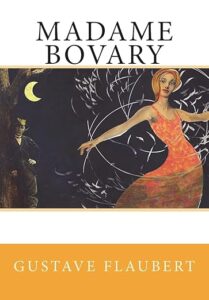
Classical novel by Gustave Flaubert from the 19th century will introduce you to the French country life of a local doctor and his unfaithful and easily manipulated wife. Deceptive introduction will make you think the story is about a young boy taking the path his mother painted for him but cannot change the inherited poor traits of his father. Charles marries a significant older lady but falls in love with a young and naïve daughter of one of his patients. What he thought was luck, turned out to be a destructive marriage.
The character of Charles was in some ways relatable for readers. He was pushed by his mother to study medicine and have better future than she had with his father, who destroyed everything her family worked for so hard. An average doctor, not best of his class, hardly even passed the final exam, but positively to say he did not kill anybody. That is plus point from my side, if we consider, that it was the 19th century with medicine and house doctors with way less knowledge as now and two or three choices how to cure anything from fever through broken bones to an incurable disease. Married to an old widow, who died not that long after that. Despite his “happy” marriage he fell in love with a young beautiful girl, who seemed to return his feelings. He made mistakes in his life, but somehow you found yourself liking him and could not be mad at him for long. He was like a small puppy. Who caused the most drama was his wife Emma around which the whole plot revolved. She fell in love with Charles, when he was visiting her father and I honestly thought they would be a nice and romantic couple. But no. Emma is a brilliant example of a young girl, who just loves and is obsessed by a thought of something, but not the essence of it. She craved after love and marriage based on the books she read, but when it came to the point and fulfilment of it, she was not satisfied and was still looking far away for some kind of upgrade. Basically, she had it all in that time. A loving, caring and good secured man with a promising career, a nice house, status of the doctor’s wife and her wealthy father who lived nearby. Honestly, this is a jackpot even today. Emma is not satisfied with her life and starts to languish. Charles decides to live their home and build it somewhere new, leaving everything behind just like that, so she can heal and be herself again. It is later revealed that Emma is pregnant.
The plot is fast evolving, but it is not something unusual for this period of time. The reading tempo is fluent, you don’t find yourself wanting to close the book. What impressed me the most was the author’s talent to describe the egoistic, egocentric and self-destructive character of Emma. It takes great talent to write about the disinterest of a mother towards her own child. So far, I met just with Tolstoy, who mastered it. She did not feel anything positive towards her daughter, even when she got hurt, Emma was annoyed by her crying and had no remorse for hurting her. She spent time and used her daughter just to have an excuse to meet with her potential lover, who was later on a real lover. We meet with multiple men, that show interest in her. I am always fascinated what bullshit men tell women just to get them where they want, mainly get them as a trophy, and women still believing it, instead of thinking twice about the words and promises coming out of their mouths. And this woman does not learn from past mistakes. How many times happened to her that a man wanted always more from her but nothing real, and she still repeated it again. Fell in love and believed in a joined future. It got the impression it was Emma’s obsession. Be loved deeply almost obsessively, but never fulfilled her soul, dreams and expectations. Her life was like a cursed cycle, always getting attached but never really lived happily. I suppose it should be a moral lesson, and it is. I cannot count how many times I was annoyed by her decisions.
It is rare, but I haven’t had one character, which I consider sympathetic, even Charles. Charles was too blind to his wife’s actions. She was not hiding her lovers from him, their neighbours, even the whole village, and yet he defended and, in his way, loved her until the near end. I asked myself a question, if Emma was corrupt from the beginning or if it was because of the environment, she lived in and let herself to be corrupted. That would be the last moral lesson I was not sure about. Both possibilities are a fine example of one’s character. Last thing to say to this novel is the connection between the characters and the author. Gustave deeply loved an older married woman for who he would do anything, but nothing came in return from her side. He changed the positions of himself with the one of Emma. She loved other men, did anything for them, but got small in return…