
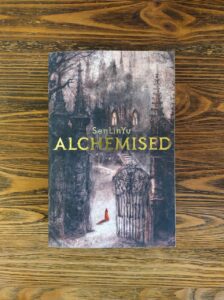
This dark fantasy novel tells the story of a young girl waking up in captivity with fragmented memories of a brutal war between necromancy and alchemy, and her own role within it.
Essentially a reimagining of Manacled, the book takes us into a new magical world where nothing and no one is safe or without sin. We follow Helena’s fight not only against her captors but also to regain her memories as the last surviving member of the Eternal Flame—a status that makes her highly valuable to the High Necromancer.
To start with the positives, the novel’s core premise is highly intriguing, and I found the first 150 pages thrilling and captivating. It is clear that a great deal of thought went into building this world, crafting its magic system, and showcasing how everything is interconnected. Exploring such a detailed new world is always exciting. Furthermore, the accessible vocabulary helped maintain a brisk reading pace.
However, the novel suffers from unnecessary length. The first 250 pages could easily have been condensed by about 100 pages without losing any core plot points. After this lengthy introduction, the story introduces a breeding program that closely mirrors the historical “Lebensborn” program. Due to the devastating war, most vivimancers and necromancers are dead, and a new generation is desperately needed to sustain the economy so the privileged elite can maintain their lifestyle. While such ideologies are abhorrent, Helena is relatively lucky to be paired with Kaine. Even though he is the enemy, he represents a familiar face compared to the strangers at the facility. Her thoughts on him particularly caught my attention: “He wasn’t cruel, he wasn’t kind, but it was enough.” Sometimes, that truly is enough, and it is a painfully accurate reflection of survival. When you have nothing, even crumbs feel like a feast—a clear sign of Stockholm syndrome developing in my opinion.
In this world, nothing is safe—not even the thoughts deep inside your head, which can be perceived or stolen through vivimancy. Losing that small, private sanctuary of your mind is terrifying, and I can completely understand why this magic was forbidden. The first part of the book relies heavily on flashbacks, which I thoroughly enjoyed. They provided brief glimpses into Helena’s past, her bravery, her choices, and the war itself. Helena’s life serves as a stark example of exploitation. No matter what she achieved, it was never enough; society constantly demanded more of her, exploiting every piece of her existence without viewing her as a human being. It makes you wonder how much someone must sacrifice to finally be left alone. She was used by everyone, including Kaine, until his stance toward her shifted. At times, her blind obedience and lack of hesitation made me question her agency.
Around page 100, you can already sense that Helena and Kaine share a past relationship or deeper feelings. Despite his cold demeanor, he is never as cruel as the others are to the losing side. The narrative hints that she is intentionally hiding him in her memories. Unsurprisingly, when this connection is finally revealed, it delivers one of the best scenes in the book. Helena unleashes her power against the Necromancers, destroying them all to save Kaine and their potential future. In doing so, she finally chooses herself—or rather, a life with him. Even though she protected his secret, she did it to secure a future over the ruins of the Eternal Flame and her friends. The book relies on a classic trope: a powerful, skilled, and loyal male lead willing to sacrifice everything for his beloved, paired with a naive, good-hearted, yet intelligent female lead who transforms into a weapon of mass destruction in times of crisis. It is a highly popular dynamic, even if Kaine has peculiar ways of showing affection. Their love story is riddled with obstacles, grief, pain, and death, beautifully illustrating Tolstoy’s famous quote: “One hundred people, one hundred kinds of love.” This was a love forged in the darkest times, proving stronger than war itself, and I found myself genuinely rooting for them. He gave her courage and self-respect, while she provided the one thing he longed for most: unconditional love. Their story isn’t perfect, but they had each other.
The novel also functions as a social experiment, highlighting the power of naivety and faith in signs and miracles during hardships. However, attributing the outcome of an entire war to a single person’s proposals felt far-fetched. For instance, the alchemists believed they would defeat the necromancers simply because they resisted Helena’s proposal to use necromancy in the understaffed hospital. Personally, I agreed with her idea. While the primary war is fought on the front lines, a second war rages in the wards. Deciding who lives and who dies heavily reminded me of the movie Pearl Harbor. The hospital staff had to deal with the grim aftermath of battle, so utilizing necromancy made practical sense. Another interesting social observation was how easily a suppressed group can be manipulated; they will fiercely back anyone promising freedom, regardless of the atrocities committed. This is exactly how the vivimancers were weaponized against the alchemists. I do not take sides here, as the Eternal Flame and the alchemists committed horrible acts as well.
Unfortunately, the grand finale was practically nonexistent. Kaine and Helena simply slip away without a trace to live the life they deserve. While this deviates from standard tropes, it felt anticlimactic and lost its momentum at the end. For me, the true climax was Helena’s earlier rage when saving Kaine. The book spans over a thousand pages, but it could have easily been trimmed to 700 or 800 pages. Many descriptions dragged out, causing me to put the book down far more often than I did at the start. For example, the sequence where Helena heals Kaine could have easily been condensed into twenty pages. Lastly, the absence of a fantasy map felt like a major oversight, as it was sorely needed to navigate the plot. In this day and age, a map is practically mandatory in fantasy novels. Overall, despite its pacing flaws, I found the plot and the core concept of the novel deeply engaging, thrilling, and captivating.